How to Store Chinese Tea and Keep It Fresh for Longer
October 9, 2026·7 min read
Do you know why some Chinese teas get better with age, while others slowly lose their flavor over time?
And more importantly, how should you store your Chinese tea?
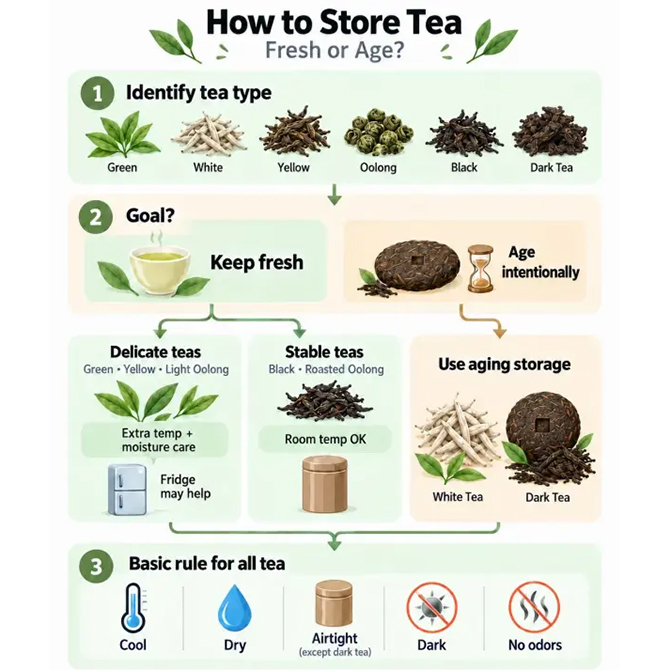
Before learning how to store Chinese tea, you first need to know what type of tea you have. If you’re not sure, you can identify the type by its taste, color, and aroma.
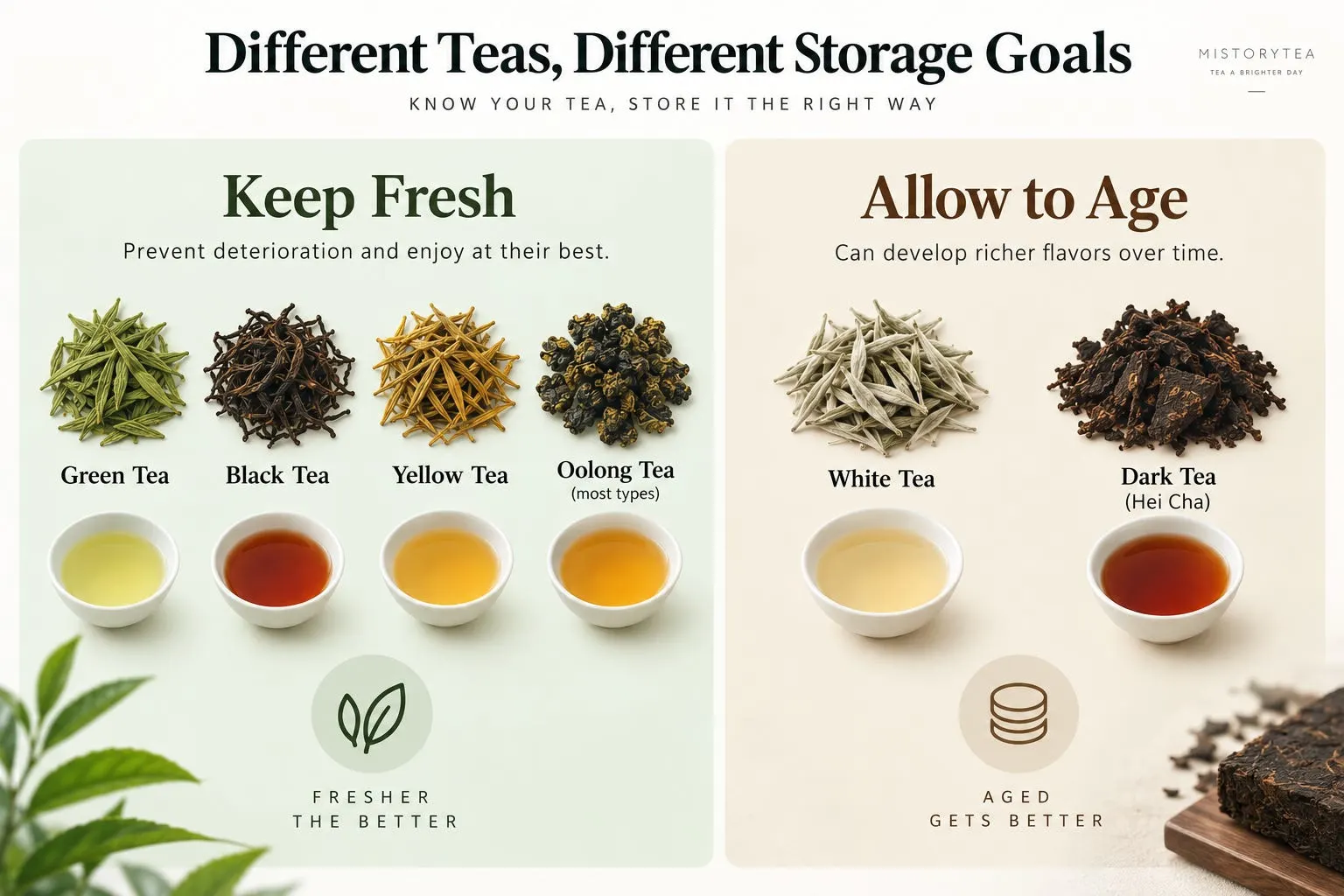
Different types of tea are stored for different purposes.
For green tea, black tea, yellow tea, and most oolong teas, the goal is to preserve freshness and prevent deterioration. These teas are generally best enjoyed relatively fresh.
For white tea and dark tea (hei cha), however, aging can be part of the experience. Certain teas in these categories can develop more complex aromas and flavors over time, and well-aged examples may become more valuable.
This happens because white tea and dark tea can undergo slow chemical and especially in some dark teas, microbial—transformations during aging. These differences are closely related to how the six major types of Chinese tea are processed.
So their storage goal can be very different: instead of simply preserving freshness, you may want to create suitable conditions for controlled aging.
This article focuses on how to prevent tea from deteriorating. If you’re interested in , let me know in the comments. I may write a separate guide about it.
Before explaining any “how-to,” I prefer to start with the principles behind it. That way, you can understand what to do instead of simply memorizing a list of rules.
The Five Enemies of Fresh Tea
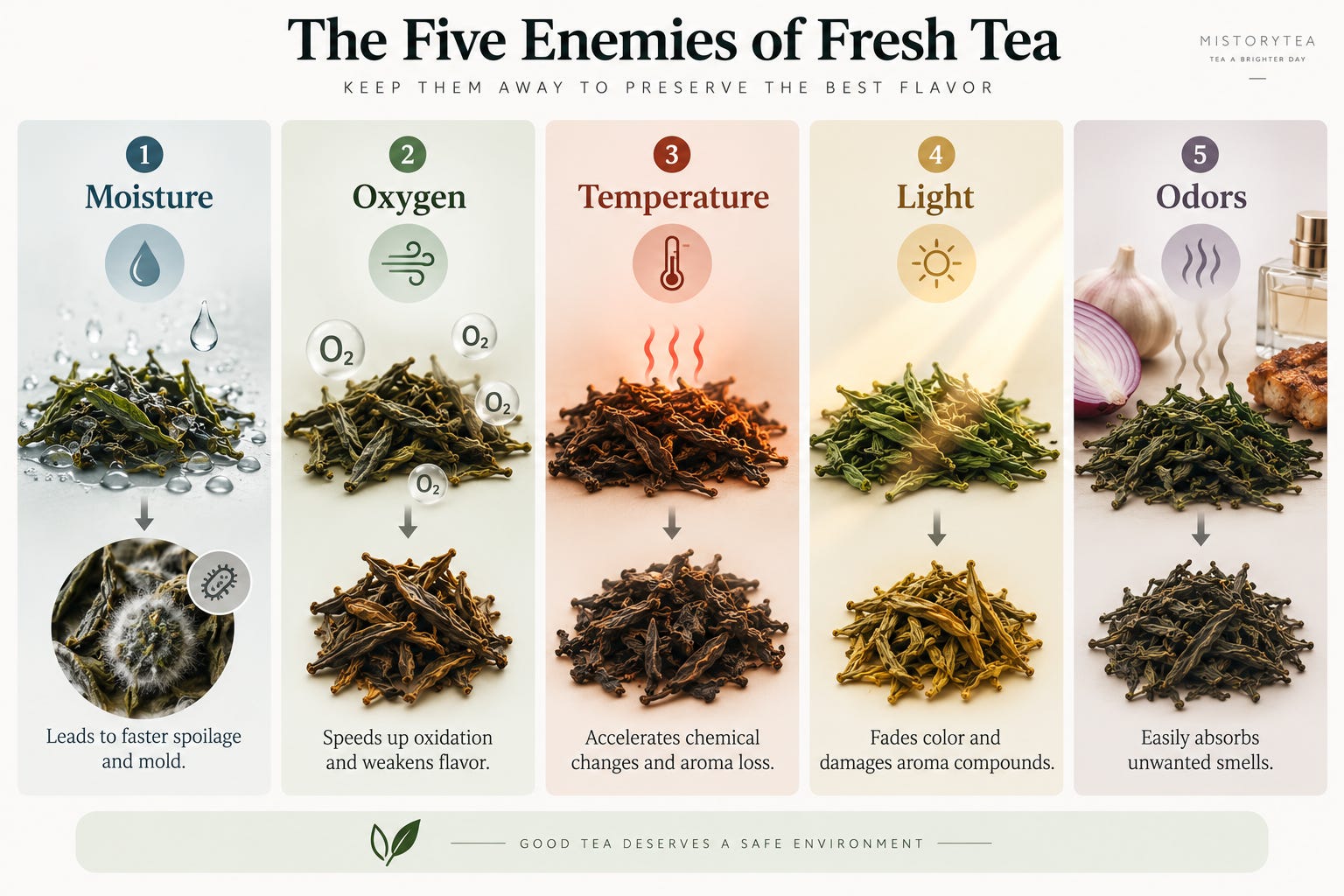
There are five main factors that affect the freshness of tea:
Moisture
Moisture accelerates chemical changes in tea and creates conditions where mold and microorganisms can grow.
Once dry tea leaves absorb moisture from the air, compounds such as tea polyphenols and vitamin C can deteriorate more quickly. Some of the compounds responsible for sweetness and freshness also change over time, causing the tea to taste flatter and thinner.
More importantly, excessive moisture can encourage mold and microbial growth, potentially ruining the tea completely.
Oxygen
Oxygen reacts with compounds inside tea leaves.
Lipids can oxidize and become rancid, while aromatic compounds can also degrade through oxidation. Over time, the tea may lose both flavor and aroma.
Temperature
Think of temperature as an accelerator for chemical reactions and physical processes.
Higher temperatures generally speed up the oxidation of compounds such as tea polyphenols and lipids.
Many of the compounds responsible for tea’s aroma are also volatile. The warmer the environment, the faster some of these aromatic compounds can dissipate, causing the tea to lose its fragrance.
Light
Light provides energy that can trigger photochemical reactions.
For example, chlorophyll can degrade under prolonged light exposure, causing the bright green appearance of green tea to fade toward yellow or brown. Lipids, tea polyphenols, and aromatic compounds may also undergo photo-oxidation, contributing to undesirable flavors and aromas.
Odors
Dry tea leaves have a porous structure and readily absorb compounds from their surroundings.
That means strong environmental odors can easily find their way into your tea and interfere with its original aroma.
Interestingly, people in China sometimes take advantage of this characteristic by using unwanted or low-quality tea leaves to absorb odors.
Of course, you probably wouldn’t want to brew those leaves afterward.
Now that we understand the basic principles, let’s look at how different types of tea should actually be stored.
Green Tea, Yellow Tea, and Lightly Oxidized Oolong
These teas are especially sensitive to loss of freshness. Green tea is unoxidized, yellow tea is lightly processed through its characteristic yellowing stage, while many fragrant oolongs are relatively lightly oxidized.
What are we trying to preserve?
Freshness, delicate aromas, floral notes, and vibrant color.
Temperature therefore becomes particularly important.
In ancient China, people obviously didn’t have refrigerators. To help preserve delicate teas, they used sealed containers and kept them in cool, dry places away from heat and sunlight.
The same basic principles still apply today.
For Short-Term Storage
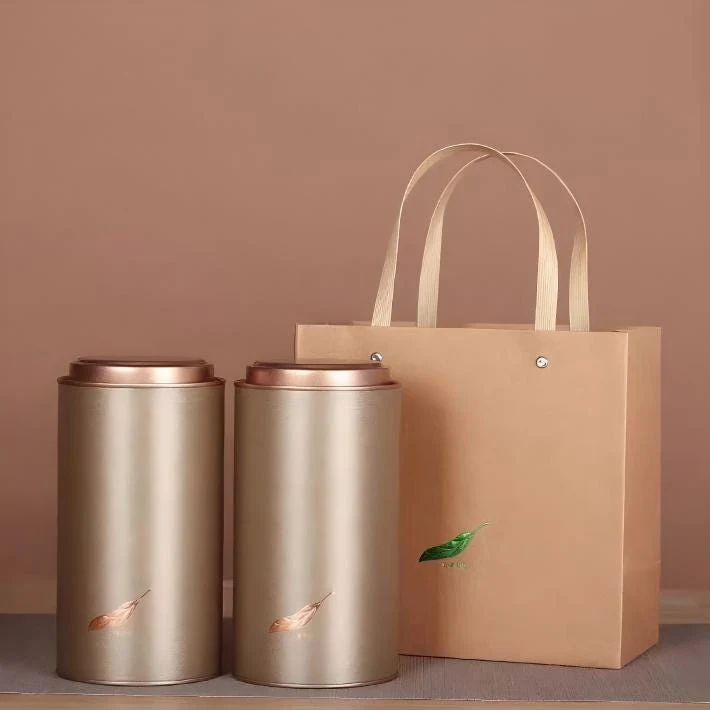
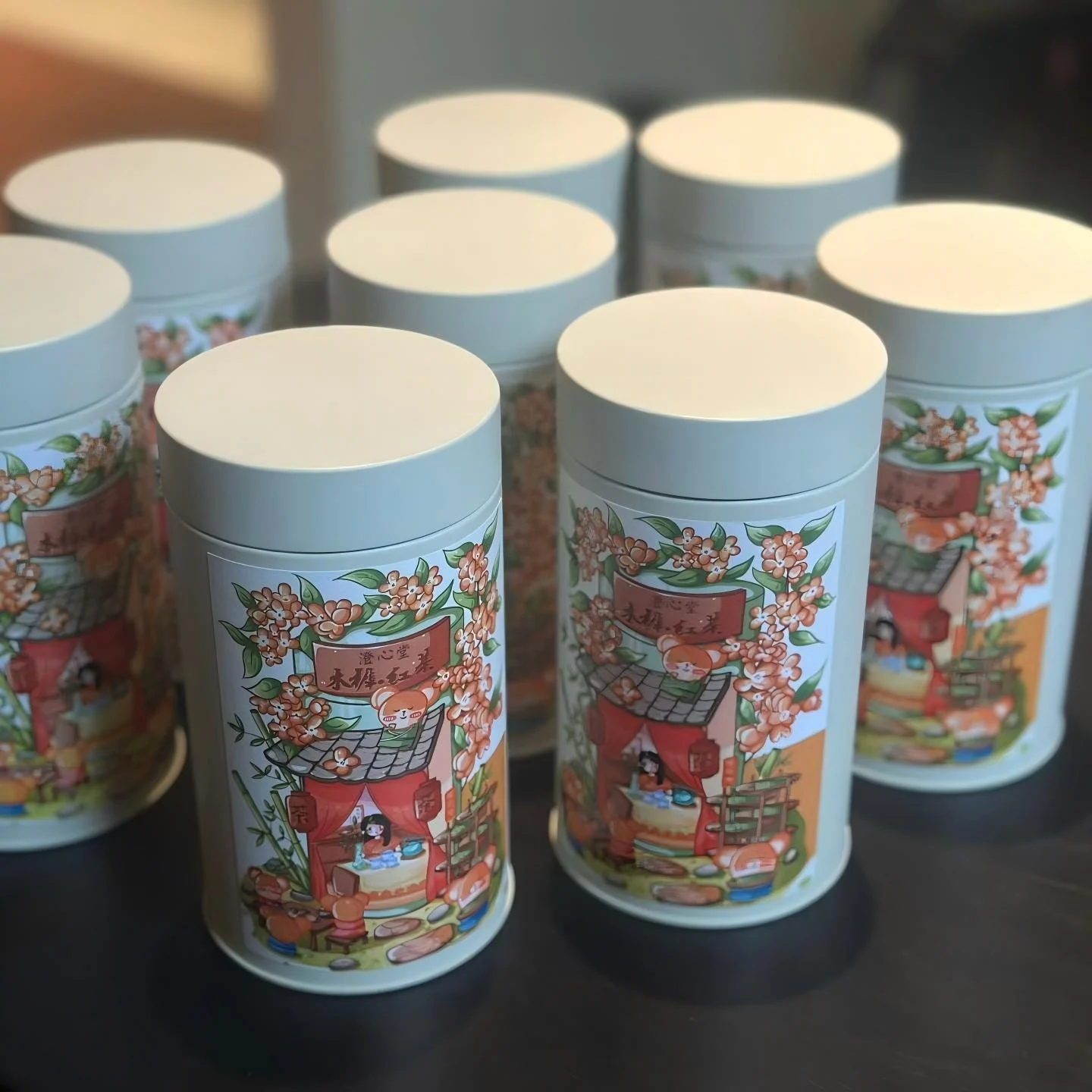
If you’re going to drink the tea relatively soon, place it in an airtight, opaque container and keep it somewhere cool and dry.
Protect it from:
sunlight
heat
moisture
cooking fumes
strong odors
I generally don’t recommend keeping delicate tea in a cabinet that contains food, spices, or other strongly scented items. Tea absorbs odors surprisingly easily—and it may end up “helping” you remove those cabinet smells.
Unfortunately, that also means those smells may end up in your cup.
If You Live Somewhere Hot and Humid
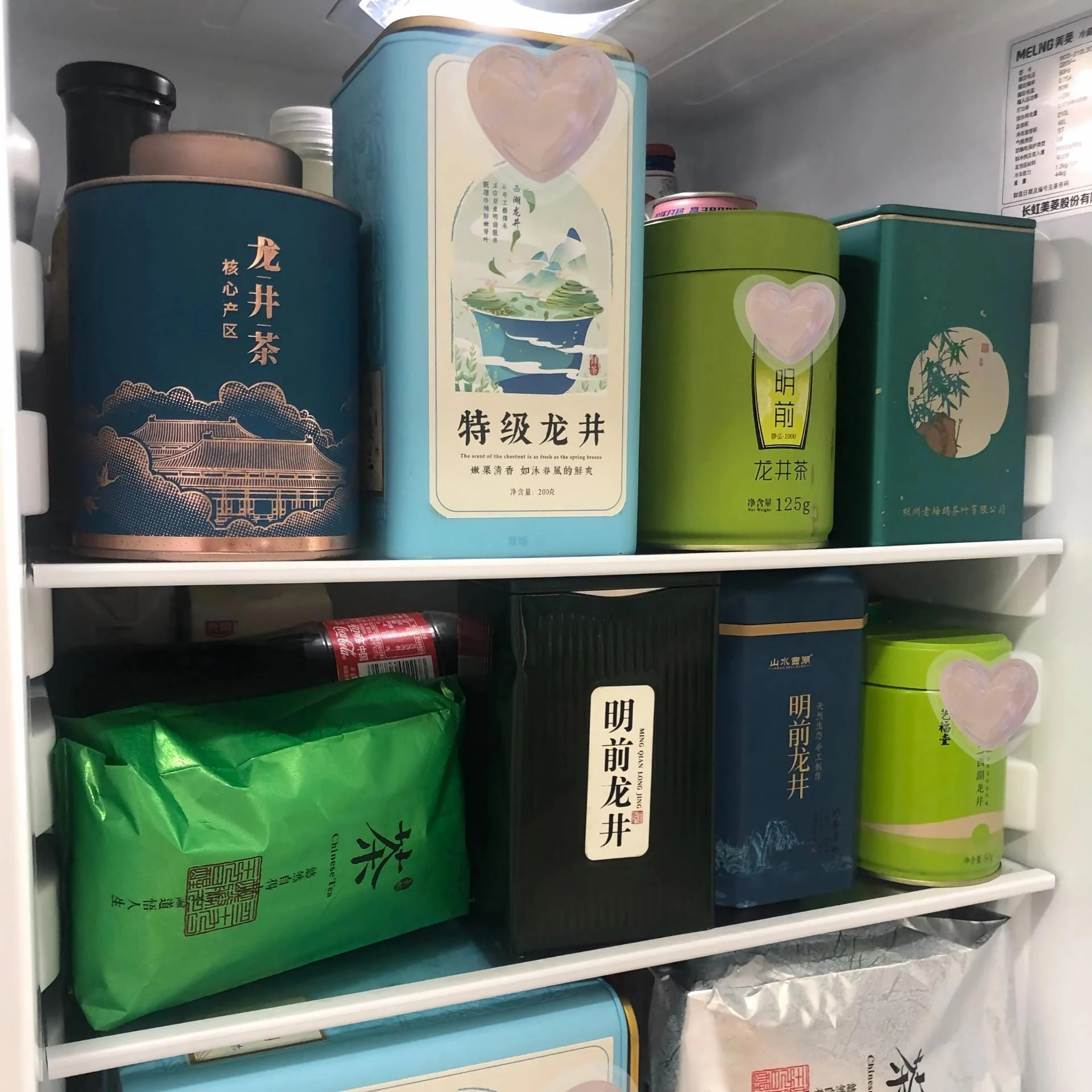
Refrigeration or a humidity-controlled storage cabinet may be useful.
First, seal the tea carefully in double-layer aluminum foil pouches. Vacuum sealing can provide additional protection when appropriate. You can then place the sealed package inside another airtight container before refrigerating it.
Refrigeration can extend freshness, but it introduces two new problems:
odors and condensation.
Never store tea loosely alongside leftovers, fruit, raw meat, or other strongly scented foods.
And when you take refrigerated tea out, don’t open it immediately.
Allow the entire sealed package to return to room temperature before opening it. Otherwise, moisture from the air can condense on the cold leaves.
An even more practical approach is to divide the tea into several small packages before refrigerating it. Each package can contain only a few servings, so you don’t have to repeatedly take the same large bag in and out of the refrigerator.
As a general guideline
Room-temperature storage: Aim to enjoy delicate teas within roughly 3–6 months for their freshest character.
Refrigerated storage: Properly sealed tea may retain its fresh character for roughly 6–12 months or longer, depending on the tea and storage conditions.
These aren’t strict expiration dates. Tea doesn’t suddenly become bad after six or twelve months. Instead, its fresh aroma, color, and flavor will gradually decline.
Black Tea and More Heavily Roasted Oolong
These teas are generally more stable.
Black tea is highly oxidized, while heavily roasted oolongs have undergone roasting that makes their flavor profile less dependent on the extremely fresh, green character we’re trying to protect in delicate teas.
As a result, strict temperature control is usually unnecessary.
For most everyday storage, simply place the tea in an airtight, opaque container and keep it somewhere cool, dry, and free from strong odors.
Keep it away from places such as:
the kitchen stove
bathrooms
perfume
spices
strongly scented snacks
Under good conditions, many teas in this category can remain enjoyable for two to three years, although their aroma and flavor will naturally evolve over time.
As for white tea and dark tea (hei cha), their storage deserves a separate discussion because the goal can be controlled aging rather than simply preserving freshness.
I’ll cover that in another article.
Summary
By now, you should have a basic framework for storing Chinese tea.
First, identify what type of tea you have.
Then, ask yourself whether the tea is something you want to keep fresh or intentionally age.
If it’s white tea or black tea, then the purpose is to age it. For other types of tea, the objective of storage is to keep freshness.
If freshness is the goal, consider whether it belongs to the more delicate group—such as green tea, yellow tea, and lightly oxidized oolong or to a relatively stable group such as black tea and heavily roasted oolong.
For delicate teas, temperature and moisture control deserve extra attention. Depending on your climate and how long you plan to keep the tea, refrigeration may be useful.
For more stable teas, ordinary room-temperature storage is usually enough.
Whatever the tea, remember the basic rule:
Keep it cool, dry, airtight, away from light, and away from strong odors.
Once you understand why these factors matter, storing tea becomes much easier than memorizing a different set of rules for every tea you buy.
FAQ
Can I store different teas in the same airtight container?
No. Different teas have different aromas, and dry tea leaves absorb surrounding odors easily. Storing different teas together can cause their aromas to mix.
It’s better to keep each tea separately sealed.
Do I need professional tea-storage equipment?
Probably not.
If you buy relatively small amounts of tea and finish them within a few months, basic storage equipment is usually enough.
For most people, all you need is:
an airtight tea container
double-layer aluminum foil pouches
If you live in a particularly hot and humid climate, a humidity-controlled cabinet or refrigerator may also be useful.
Thanks for reading this article from MistoryTea. If this article helped, share it with someone who would enjoy the next cup.
The MistoryTea Letter
More tea stories, thoughtfully told by MistoryTea.